
Rendering Systems
Silicone Rendering in Southend, Essex
Render on this stretch of the Essex coast has a harder life than it does inland. Salt carries a long way up the estuary, south-facing elevations take the weather head on, and a lot of Southend’s older housing has solid walls with no cavity behind them. Gez renders with all of that in mind.
Silicone, monocouche and traditional sand and cement — for homes, extensions and commercial property across Southend, Leigh-on-Sea, Westcliff, Shoeburyness and Rochford.
Start With the Wall You’ve Got
Most of the failed render Gez is called out to look at didn’t fail because of the product. It failed because the wrong system went onto the wrong wall, or because nobody checked what was behind it first. Southend throws up four common situations, and each one points at a different answer.
Solid brick, no cavity
Leigh · Westcliff · The old townThe Victorian and Edwardian stock along the top of the cliffs and back through Westcliff is largely solid brick. Those walls have always handled moisture by letting it move through and dry out again. Seal them with a dense cement render and the water still gets in — at the sills, around the openings, through hairline cracks — but it can no longer get out. It sits in the wall, pushes the render off the brick, and shows up inside as damp on the chimney breast or below the windows.
Usually the answer: a breathable system, which in practice means silicone. On a solid wall this isn’t a preference — it’s the difference between render that lasts and render that blows in five years.
Pebbledash at the end of its life
Southchurch · Thorpe Bay · The seafront estatesThere’s a lot of sixties and seventies pebbledash across these streets and much of it is now finished — hollow patches, spalled areas under the eaves, stones dropping into the borders. The question is never whether it looks tired. It’s whether it’s still properly keyed to the brick underneath, because rendering over a surface that has already let go just means the new finish comes away with the old one.
Usually the answer: an honest assessment before anything is quoted. Sound pebbledash can be worked over. Anything hollow or blown has to come off first, and that changes both the price and the timescale.
Blockwork extensions and newer builds
Shoeburyness · Rochford · The newer estatesExtensions, garage conversions and newer housing are a cleaner proposition — square, cavity-built, and a straightforward background to work on. The difficulty here is rarely the wall. It’s matching: new render against a weathered existing elevation almost never blends invisibly, however carefully the colour is chosen.
Usually the answer: monocouche or silicone both sit well on clean blockwork. The real decision is whether to render the addition alone or take in the whole elevation, and it’s worth settling that before work starts rather than after.
Anything with a clear run to the water
The seafront · The cliffs · Roads off the BroadwayProperties with an open aspect to the estuary get salt-laden air and wind-driven rain that houses a few miles inland never see. Water repellency and colour stability matter far more on those elevations, and cheaper systems show their age there first — usually as staining and patchy fading on the exposed face while the sheltered side still looks fine.
Usually the answer: silicone on the exposed elevations at minimum. It’s also worth thinking about whether the whole property goes the same way, purely so it weathers evenly.
The Systems Themselves
Gez fits all four. Here’s what each one actually gives you and what it costs you in return.
Sand and Cement Render
The traditional method, and still the sensible choice on plenty of jobs. It builds out an uneven wall, takes a pebbledash or Tyrolean finish where you’re matching neighbouring properties, and it’s the easiest system to repair — a patch can be blended and painted rather than needing a whole elevation redone.
Its weakness is rigidity. It moves less than the wall behind it, so it cracks, and once painted it joins the maintenance cycle for good.
Monocouche Render
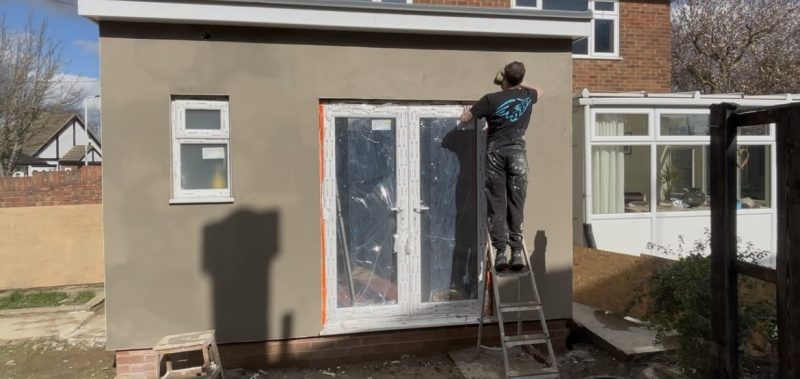
A through-coloured render applied in a single pass. Because the colour runs the full depth, a scratch or chip doesn’t expose a different shade underneath, and there’s no painting once it has cured. It suits new blockwork well and goes on quickly.
It’s less water-repellent than silicone, which counts against it on the exposed elevations near the water, and it holds dirt more readily in a marine atmosphere.
Silicone Render
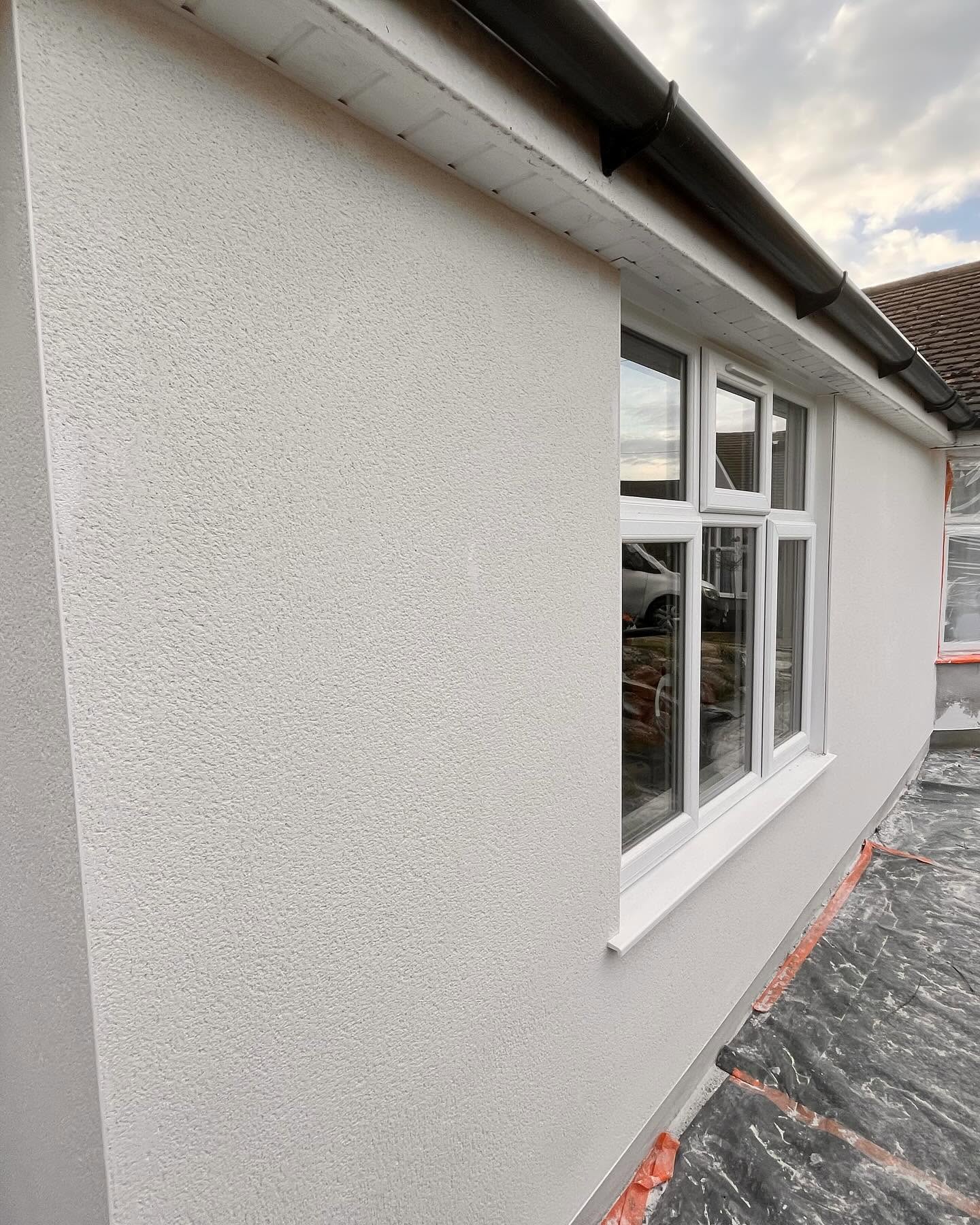
The system most Southend jobs end up on, and for good reason. Silicone render is water-repellent at the surface but still breathable, so a solid wall can dry outward while rain runs off rather than soaking in. It’s flexible enough to absorb the small movements that crack cement render, and the colour range is wide.
On seafront and cliff-top properties that combination is what keeps a finish looking right after a few winters. It costs more up front, and like monocouche a patch repair is difficult to hide, so it earns its money on exposed walls rather than sheltered ones.
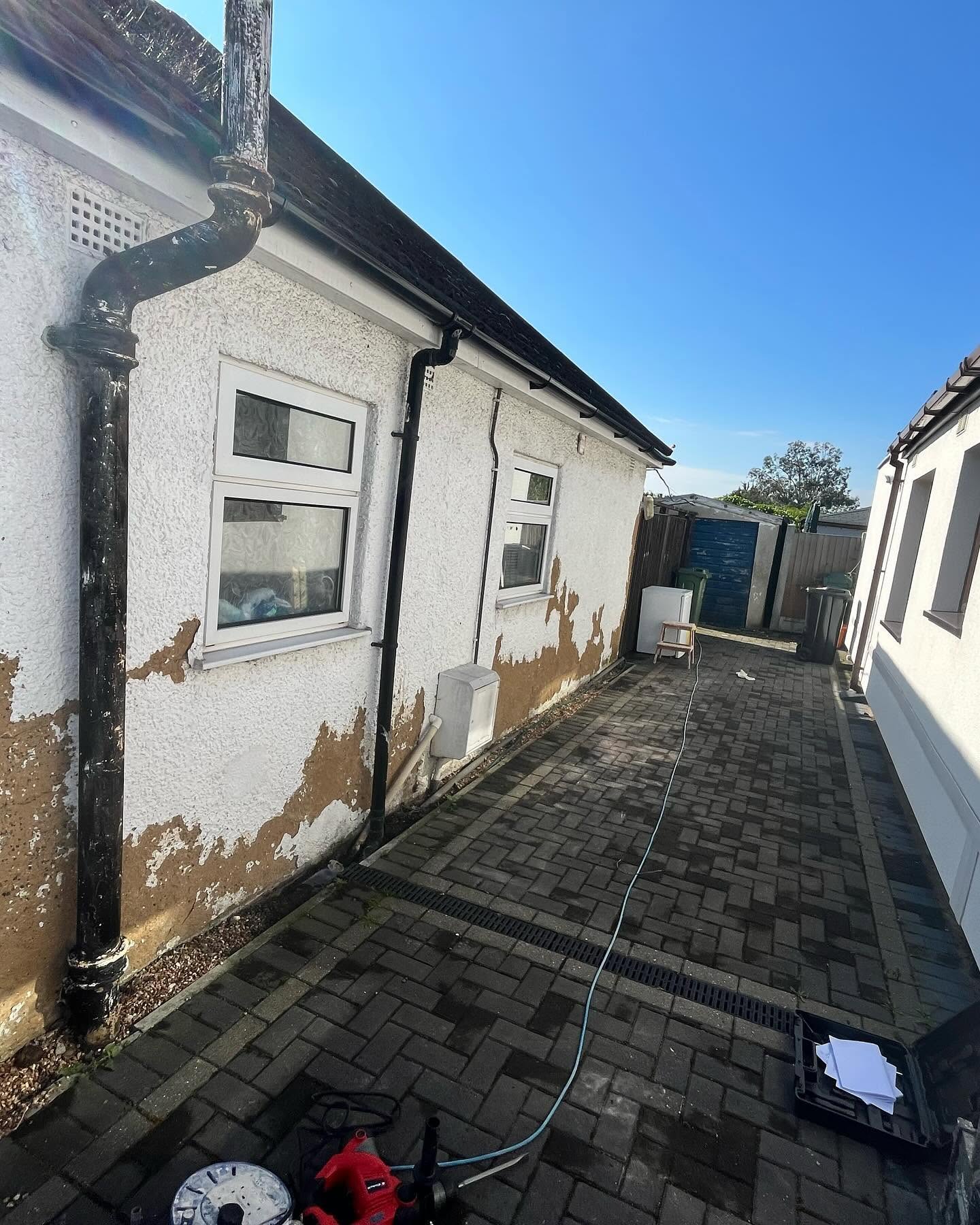
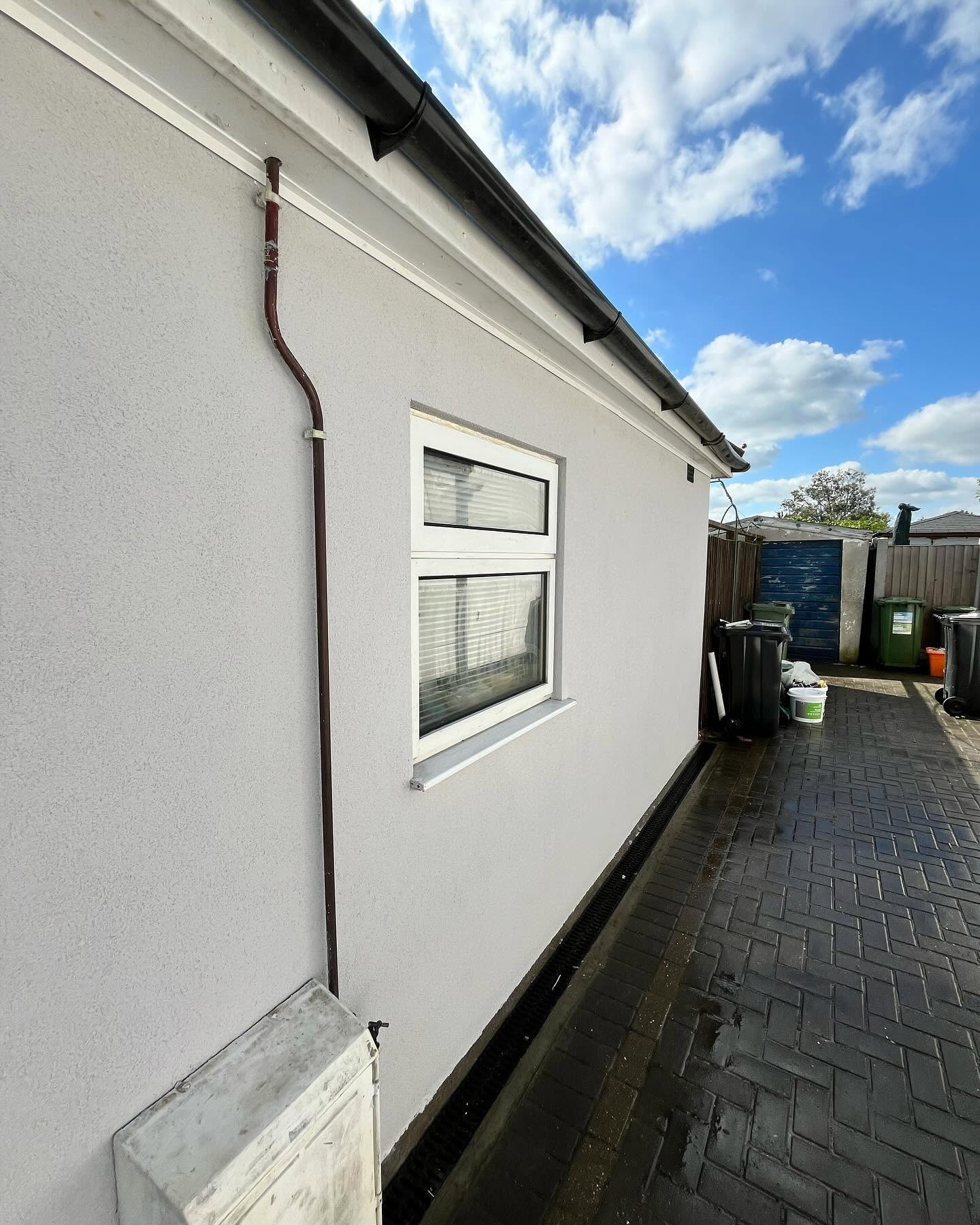
Silicone render, Southend — before and after
External Wall Insulation (EWI)
EWI fixes insulation board to the outside of the wall and renders over it. On Southend’s solid-wall stock it’s often the only practical way to insulate at all, since the alternative is losing room size to internal insulation on properties that frequently don’t have it to spare.
It’s the most expensive route and it changes the look of the building — reveals deepen, sills need extending, and the elevation sits proud of where it did. On a terrace or a property with detailing worth keeping, that needs thinking about before you commit.
Rendering Questions
Can existing pebbledash be rendered over?
It comes down to how well the pebbledash is still holding to the brick. Where it’s sound across the elevation it can usually stay and be worked over. Where large areas have let go, leaving it in place only guarantees the new render fails with it, so it comes off first. That judgement gets made on the property, not over the phone.
Which render suits a house near the seafront?
Usually silicone. Elevations facing the estuary take salt-laden air and wind-driven rain, and silicone’s combination of water repellency and breathability handles that better than monocouche or cement render. On a sheltered rear elevation the choice is more open.
My house has solid walls — does that change things?
Yes, significantly. Solid-wall properties dry outward through the wall itself, so a dense cement render can trap moisture and cause damp internally. A breathable system is the right approach. Much of the older housing in Leigh, Westcliff and Southend’s old town falls into this category.
How long does a rendering job take?
A single elevation is often two to three days including preparation and drying between coats. A full house is usually a week or more. Weather has a real say in it — render can’t be applied in frost, heavy rain or strong direct sun, so you’ll get a realistic window rather than an optimistic one.
Do you render extensions to match the existing house?
Yes, and it’s worth discussing early. New render rarely blends invisibly into weathered older render, so on some jobs the better result comes from doing the whole elevation rather than just the new section.
What areas do you cover?
Southend-on-Sea, Leigh-on-Sea, Westcliff-on-Sea, Shoeburyness, Thorpe Bay, Southchurch, Rochford, Hadleigh, Benfleet and the surrounding Essex areas.
Get a Free Rendering Quote
Send Gez a few photos of the elevation along with rough measurements and your location, and he can advise on the right system and give you a free, no-obligation quote.